 Back to reading, and perhaps the gem of the season was ALRAUNE (1911) by Hanns Heinz Ewers, which I finally found in a handsome and not-too-unreasonably-priced edition from England. Ewers was a big noise in the early German cinema (he wrote STUDENT OF PRAGUE among others) and he authored a trilogy of horrific novels that includes ALRAUNE, THE SORCERER’S APPRENTICE (1910) and VAMPIRE (1927).
At the time ALRAUNE was written, early experiments in artificial insemination were gaining notoriety (The practice was officially condemned by the Catholic Church in 1909) and must have seemed fertile ground for the seeds of Ewer’s kinky imagination. In his mind, the creature of such an experiment is a being without a soul, and the product he envisaged became a woman who drives everyone around her to ecstasy and ruin. Such is Alraune, named for the mandrake root that supposedly grows under the gallows and screams when pulled from the ground.
Neat-o. And Ewers does the thing up nicely, with a cunningly understated story, hinting at more than it shows, and incredibly tactile prose that conveys the feel of fabric, skin and sharp steel quite vividly. The last part of this novel details an extended sexual affair between Alraune and her final victims, and it’s written with a coy self-censorship I found intriguing; Ewers gives us every detail, not in graphic terms, but in vivid metaphors that carry the image wonderfully. Indeed, ALRAUNE may be the most sensual of horror stories, and the most unsettling aspect of it is that the horror and sensuality fit so wonderfully together, in a book I won’t soon forget.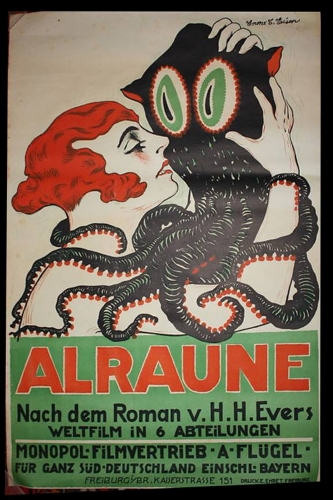
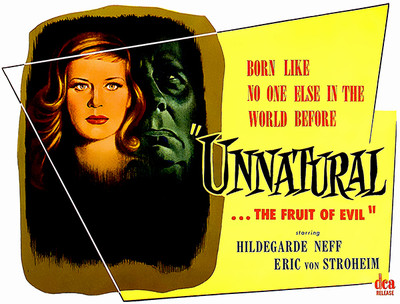
The novel was adapted for film three or four times, most recently in a much-maligned, badly-dubbed little thing called UNNATURAL (Germany,1952.) Or maybe it’s called ALRAUNE; it was released under both titles and generally ignored no matter what they called it.
Hard to say just what it is about this film that draws me so irresistibly. Maybe it’s the atmosphere of romantic depravity. It’s certainly not the choppy editing or the atrocious dubbing, though they add an element of dream-like unreality to the experience, particularly when the camera cuts from a scene filmed on some elaborate set or colorful location to one obviously shot in front of a painted backdrop—or even, in one case, on an empty black soundstage. Scenes seem to start and stop here for no discernible reason: the film may come in on the middle of an argument or cut away before it’s resolved, yet it somehow still tells its twisted story.
The story. Yes, the story. Well, the story as adapted here actually catches something of the morbid fascination with science and sex found in the book. UNNATURAL tells of a woman created by artificial insemination (borderline sci-fi back then) who has no soul: innocent herself, but compelled to drive those who love her to recklessness, crime, and self-destruction.
Well, we’ve all had relationships like that, haven’t we? I think I dated her sister her a few times in College. But Ewers gives it to us in its purest form, and UNNATURAL relates it with a strange, syrupy romanticism: like what you’d get if Max Ophuls directed TEXAS CHAINSAW MASSACRE.
Like I say, I’m not sure why I find this so rich and watchable. Maybe it’s the patently ersatz innocence of Hildegard Neff (sometimes looking alarmingly like Eve Arden!) as Alraune, set against the relaxed depravity of Erich Von Stroheim as her creator: complementing rather than contrasting. But mostly I think it’s the rich imagery. The photographer of ALRAUNE was himself a veteran of the German Silent Cinema, having worked with Lang and Murnau, and he makes this film a delight for the eyes as he picks out unsettling details in the background, or sets up a love scene in dark, sinister lighting. There’s a splendid final montage, dissolving from a dead figure to a withered root, which assumes the shape of a twisted man and finally settles on the image of one ascending the gallows as Alraune’s destiny works itself out. Pure abstract cinema and a film I’ll revisit.
 A word of caution: Ewers reputation is somewhat shady in literary circles. He was an ardent supporter of the Nazi party in its early days and wrote a (mostly fictional) biography of one of its martyred leaders, Horst Wessel, in 1932, but fell out of favor when he began supplying his Jewish friends with passports to flee Germany after Hitler came to power. His homosexuality made him something of an embarrassment to the ruling party, and he died in Berlin in 1943, where there was a lot of that going around at the time.